|
|
Posts Tagged ‘New York Times’
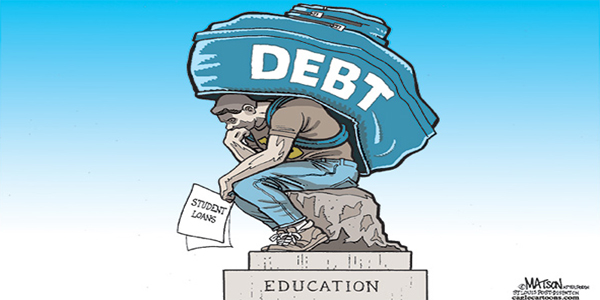
Some Thoughts on the Movement to Forgive Student Loan Debt
October 9th, 2011 | Added to Money, Jobs, & Finances, Student Loans | No Comments »
A few years ago I was a supporter of the online movement to forgive student loan debt to stimulate the economy. And, in many respects, I’m still a supporter of the concept. As the movement is beginning to gain some more momentum (though not enough for it to be implemented in some form, which is a shame), I thought that given my expansive experience in repaying student loan debt I’d offer just a brief commentary giving some of my thoughts on the issue.
To begin, if you really want to read up on this issue you should head over to the Forgive Student Loan Debt website – tons of information over there on the idea and concept. More recently, the New York Times commented on the concept of forgiving debt in a commentary posted to their website, which you can access by clicking here. The New York Times piece makes a good point about the downside of forgiving debt, in general, when it suggests:
To start, writing off debts would not necessarily increase economic growth. Every liability is also an asset, so while a dollar that is no longer required for debt repayment might add some cents to consumer spending, it is also a dollar cut out of a bank’s capital or of an investor’s net worth — subtracting from resources and confidence.
And write-offs big enough to change consumer behavior would probably be big enough to destabilize banks. The Federal Reserve or the government would need to help, presumably by injecting newly printed money as capital. Such government control is usually inefficient, and abundant printing of money increases the risk of uncontrolled inflation, which has its own way of making people feel poorer.
The issue of moral hazard also cannot be ignored. Much of the excess debt was incurred through irresponsible mortgage refinancing, which peaked in 2006 at $322 billion, representing 2.4 percent of G.D.P. The reckless use of houses as A.T.M.’s was a major factor in decapitalizing and destabilizing the American economy. Forgiving such debts will teach the wrong lesson: borrow in haste, repent never.
Okay. They’re right. I get it. Makes sense. But what about student loan debt? Does forgiving student loan debt make any difference in this equation? I think so.
Sure, I agree with the New York Times about the moral hazard issue and I would hate to see folks incur massive amounts of debt only to discharge that debt via bankruptcy a year after graduating. That wouldn’t be right. However, I would like to see a system that allows for some level of forgiveness for student loan debt after a certain period, time spent working at a certain job, or some other logical qualifier. The federal government has a program that like that right now where after working for a nonprofit organization or for the government for ten years, the balance of your student loan can be forgiven (the program is so much more complicated than that, but you can look it up if you want to know more about it).
Megan McArdle wrote a very good article in The Atlantic the other day about this issue. I think that my point of view is very much in like with Ms. McArdle’s thoughts. In her article, she writes:
By allowing students to shift forward the additional income that their degree will earn them, student loans have allowed universities to capture a huge portion of that future income stream–which really hurts those for whom that stream doesn’t materialize. Moreover, it allows students to make the sort of stupid choices that most 19-year-olds will make if they’re allowed. I don’t have a lot of patience for university administrators claiming that they just can’t possibly charge less than $25,000 for 15 hours a week worth of classes, but they do have one point: they build expensive new facilities and load on the services because students demand them, and threaten to go elsewhere if they can’t get them. Colleges look ever-more like four year resorts with a sideline in academic research.
If students actually had to earn the money to pay for that world-class fitness center, the 2,000 different clubs, and the off-campus apartment with the pizza parties, there would be a lot less of those things. And while I like both world class fitness centers, and apartments, they’re not the sort of thing that should be funded with borrowed money. If the degree caused pain now rather than pain later, they might also think harder about whether what they were studying was likely to deliver a solid return on that investment. I’m not faulting the students–the future is a pretty hazy concept when you’re eighteen. I’m just arguing that it’s not necessarily helping to enable them.
For me, this is the crux of the issue. I’ve been saying for a while that I really don’t like the social system we’ve built in this nation where we tell young people that their ideal life is to do well in high school, immediately go to college, and then begin working for the next 35 – 40 years of their lives. That’s not conducive to the type of futuristic, 21st Century society that we should be building. Yet, we’ve not only created this social ideal, but we’ve found a way to fund it in a manner that allows colleges and universities to make a ton of money! That’s not conducive to many things including increasing the value of a college degree in the workplace (which colleges should be concerned about) and increasing college graduates’ personal wealth (which all college graduates and their families should be concerned about). So, as the folks at the Forgive Student Loan Debt website can tell you – the system is clearly broken.
I’m not the type of person to throw the baby out with the bathwater, though. And it is in that mindset that I believe we shouldn’t forgive 100% of student loan debt. Instead, we need to fundamentally change the system for both current borrowers and future borrowers. For example, to address the concerns of those borrowers who currently have outstanding student loans and are struggling to repay them, we need to create truly flexible repayment programs. In other words, we don’t need to capitalize interest on loans that are in deferment – we need to eliminate the interest on those loans, period. For a private banker, that’s the epitome of a risky loan so I understand that this type of recommendation will likely create a culture shock at the local bank. However, if I’m the guy who runs the local bank, I’m more concerned about having my principal repaid – even if it’s over time – than having a loan go into default because the total burden was too much for the borrower.
And on the same note, if banks continue to want to fund student loans, then they need to do better underwriting to make sure that the person who takes out the loan can repay it once the time comes for repayment. But that’s a topic for another post entirely.
For future borrowers, I’d be in favor of a graduated borrowing schedule and a total student loan cap. I don’t know what number would work or what the system would look like in its final form, but I don’t see why we couldn’t form a program where students are allowed to borrow (for example) up to $10,000 during their Freshman year, $8,000 during their Sophomore year, $5,000 during their Junior year, and then $3,000 during their Senior year. In total, that’s $26,000 worth of student loan debt (which should also have flexible repayment options and a very low interest rate). Repaying that amount of student loan debt is totally reasonable. Plus, a graduated debt schedule might entice students who do not currently work to get a part-time job (or two) while in school. It would also encourage students to think twice about those stupid choices that Ms. McArdle references above.
What it comes down to is education about the system. In the current system or in a revised system, more people just need to understand the entire student loan industry before they choose to take out those loans. And I think we’d be hard pressed to try to force all of the knowledge into the heads of young people. Instead, we need to be sure that the parents and guardians are more aware of what the implications of these students loans are in the long-term and hope that they educate their kids about the possible outcomes. There are always going to be outlier situations, of course, where some folks get themselves in very deep debt. But if we – as a society – understand the issue better, we might be able to find a reasonable way out of this hole.
For me, though, I’m in favor of some form of forgiveness of student loan debt. I’d probably focus on eliminating the capitalized fees, interest, and penalties from the student loan balance first. Then, I’d try to encourage the expansion of the debt forgiveness program I referenced above. Again, we don’t need to eliminate the entire system – we just need to recognize that it is broken and begin working to really fix it – right now.
You Really Should Stand Up as You Read This Entry
July 2nd, 2010 | Added to Random Entries | No Comments »
Today I’m switching gears from the charter school advocacy and education reform entries that I’ve been posting all week. Instead, today we take a quick look at the office and see where we can improve the aura of the workplace. A few months ago the New York Times posted an entry on one of its blogs that talked about why you should stand up when you work. What did the blog entry argue as the main reason to get up while working?
So part of the problem with sitting a lot is that you don’t use as much energy as those who spend more time on their feet. This makes it easier to gain weight, and makes you more prone to the health problems that fatness often brings.
But it looks as though there’s a more sinister aspect to sitting, too. Several strands of evidence suggest that there’s a “physiology of inactivity”: that when you spend long periods sitting, your body actually does things that are bad for you.
As an example, consider lipoprotein lipase. This is a molecule that plays a central role in how the body processes fats; it’s produced by many tissues, including muscles. Low levels of lipoprotein lipase are associated with a variety of health problems, including heart disease. Studies in rats show that leg muscles only produce this molecule when they are actively being flexed (for example, when the animal is standing up and ambling about). The implication is that when you sit, a crucial part of your metabolism slows down.
Pretty bad stuff, huh? But wait, the blog entry goes on to talk about how reducing physical activity actually hurts people who are already physically fit. Take a look at this research:
Nor is lipoprotein lipase the only molecule affected by muscular inactivity. Actively contracting muscles produce a whole suite of substances that have a beneficial effect on how the body uses and stores sugars and fats.
Which might explain the following result. Men who normally walk a lot (about 10,000 steps per day, as measured by a pedometer) were asked to cut back (to about 1,350 steps per day) for two weeks, by using elevators instead of stairs, driving to work instead of walking and so on. By the end of the two weeks, all of them had became worse at metabolizing sugars and fats. Their distribution of body fat had also altered — they had become fatter around the middle. Such changes are among the first steps on the road to diabetes.
Certainly not good news by any stretch of the imagination. Part of me believes that the reason why I’ve been hit with an onset of Type 2 Diabetes is because of the dramatic change in lifestyle that I underwent during the latter part of 2006. It was at that time when I graduated from graduate school and began working full-time. Working full-time forced me into a two-hour daily commute (which used to be the two hours I would spend in the gym) as well as to sit behind a computer for the vast majority of my day. Not a good change for a person who is prone to gaining weight, you know?
If you have a chance, click on the link to the article that’s posted above. I think you’ll enjoy reading it.
Even the New York Times Sees the Value in Christie’s Cuts
March 26th, 2010 | Added to Money, Jobs, & Finances, The State of New Jersey | No Comments »
Last Sunday’s New York Times published an article that talked about the budget cuts proposed by Governor Chris Christie during last Tuesday’s budget address. What I like about the New York Times article is that they explicitly cite how most union members feel about the cost of living in New Jersey.
But what’s most surprising about New Jersey is how in such a blue, labor-dominated state, Democrats and union members seem to be cracking under the pressure of the state’s tax burden, revealing a kind of split-personality disorder.
The syndrome surfaced last summer during Mr. Christie’s campaign, when he vowed to bring New Jersey’s property taxes, the nation’s highest, under control. As a candidate he saved his sternest threats for the teachers’ and state workers’ unions, whose healthy pay and benefits packages, he argued, were slowly strangling the schools and running the state’s finances into the ground. Union members, state workers and teachers, it turned out, weren’t offended by his rhetoric. In fact, public opinion surveys showed they ate it up.
The New York Times leans left on most, if not all, issues. This is why you see the writer suggesting that it is surprising how the people in New Jersey are mostly for Christie’s cuts. However, the truth is that even the hardest leftist person in this state can understand how our current tax and overspend system is not sustainable. When you have a tax and overspend system, there are two basic ways to fix it: spend less or tax more. Governor Christie, to his great credit, has opted for the traditionally unpopular fix by spending less money.
Spending less money means cutting the amount of programs that can be funded and it was high time that someone came along to New Jersey to cut back the unnecessary, duplicitous programs that this state offers. The New York Times article cited above says that the public ate up Governor Christie’s message on the campaign trail. You’re damn right we ate it up! Finally, we had a guy talking sense instead of spewing the typical “vote for me” crap that previous politicians put out there. Plus, Christie had the good fortune to run against a man who will go down in history as one of the worst Governors in New Jersey history. More from the New York Times:
No polls have been taken since Mr. Christie’s budget speech, but it held few real surprises. “Voters felt Christie was being honest about what the situation was, and what he needed to do to move forward, and then he did exactly what he said he was going to do,” Mr. Murray said. “It’s a sad statement, but that’s almost unheard of.”
This is the part of the outrage that makes me laugh the hardest. People are actually outraged that Governor Christie instituted the hard spending cuts that he said he would during the campaign. For those of you who don’t have the luck of living in the Garden State, we don’t expect our politicians to tell the truth…ever. Governor Christie, on the other hand, is actually doing what he said he would do and it’s great!
These spending cuts are what New Jersey needs. There’s no question about it.
Are High School Guidance Counselors Doing Their Jobs?
March 6th, 2010 | Added to College & Fraternity Life | 2 Comments »
There was a time when if you wanted to get my Mother, who reads this blog (hi Mom!), really pissed off all you had to do was ask her about my high school guidance counselor. Forget about it! My Mom used to get really fired up over what my high school counselor did, or more aptly didn’t do, for me when I was a high school student.
Oh, this is going to be one of those longer entries that deals with a personal story from my past which I think you might find entertaining. So sit back and relax and read a little bit of my history…
Before I get started with my story, I thought that I would let you know how this memory was dug out of the recesses of my mind. The other day the New York Times published an article that talked about how high school guidance counselors are receiving failing grades from their students. The article says:
Most people who graduated from high school in the last dozen years believe that their guidance counselors provided little meaningful advice about college or careers, a new study has found. And many said the best advice on their futures came from teachers.
“Most young adults who go on to college believe that the advice of their high school guidance counselors was inadequate and often impersonal and perfunctory,” according to the study by Public Agenda, a nonprofit research organization.
I just fall into that category of people who have graduated high school in the last twelve years. And I can safely say that my high school guidance counselor strongly falls into the category of someone who never gave me “meaningful advice about college or careers.” She definitely “was inadequate and often impersonal and perfunctory.” Frankly, she absolutely sucked at her job and I hope that she didn’t do to other students what she did to me.
Intrigued yet? Read on!
Let me set the stage. I was always an outstanding student. I swept the eighth grade graduation winning almost every academic award that Mount Arlington Public School offered including the Academic Excellence award. It was the same story in high school, where I routinely received straight A’s in honors and advanced placement classes. On top of being a great student, I was a highly involved student, too. I was Vice-President of my Freshman class and then President of my class through Junior year when I became the President of the Student Council for my Senior year. I was a varsity starter on the football, wrestling, and spring track teams and captain of the wrestling team in my Senior year. I was the New Jersey State Interscholastic Athletic Association scholar athlete of the year my Senior year in high school. I was in a bunch of honor societies including the National Honor Society. I even wrote for the school newspaper!
Needless to say, I was clearly a highly involved student – and not just “involved” with bullshit clubs that had two or three members. I was one of the leaders in my high school of approximately 1800 students.
So we’ve set the stage.
When a kid like me is getting ready to start applying to colleges, he obviously gets offers from all over the place. Now, I could go into how we were bombarded at my house with letters and packages from colleges who wanted me to apply, but that would detract from the story about how inept my old guidance counselor was during my senior year. So we’ll focus on a few schools – Muhlenberg College, Bloomsburg University, Harvard University, Princeton University, Rutgers University, and Monmouth University. Why focus on just these schools? Because these are the ones that I applied to when I was in high school.
In truth, I really wanted to go to Muhlenberg College because my football coach had worked out an arrangement for me to get, essentially, a free ride at the school where I would be playing football and possibly even wrestling in the off season. That’s what I wanted to do and I was glad that an arrangement was being worked out – I even remember meeting with the Muhlenberg College coaches on one of their visits to Roxbury High School my Senior year. In fact, I only applied to the other schools just because I wanted to see what the responses were (although I did apply to Monmouth University because they were also recruiting me to play football – which is a story for another time).
Like any overachieving student, I prepared all of my college applications well in advance of their due dates and brought them to my guidance counselor at Roxbury High School at the beginning of October in my Senior year (this would be October 1998). The reason I had to bring them to my guidance counselor was so she could attach my official transcript and get them out during the early admission period. Roxbury High School also had a service where they sent the entire application package out on behalf of the students, which was great! So, I brought my applications to the guidance counselor, she told me they would be sent off by the end of the week, and that was the end of that process. She also mentioned that sometimes colleges take weeks or even months to get back to the applicants, so I should sit tight for a while.
And I sat tight…
My senior year of football was incredible. We were going at a million miles an hour and we wound up winning the first state championship in Roxbury High School history which was major news in our town. From that victory I went on to become the captain of the wrestling team and I even won one of the winter tournaments that the wrestling team went to each year. I was pretty packed with things going on and while the college letters continued to come in, they eventually stopped coming in altogether at some time in January 1999. I thought this was weird so I asked my guidance counselor what was going on and I also brought up that I hadn’t heard from any of the schools that had I applied to yet. She told me that the applications were sent and that she would follow up with the colleges to see if they had accepted me yet.
My guidance counselor never got back to me with an update.
The months kept going by and I never heard from any of the colleges. Finally, at some point at the end of March 1999 I went in to my guidance counselor’s office and asked her what I should do. She said that she would follow up with the colleges and get back to me (sound familiar?). At this point, I began to get the impression that she was incompetent and that something must be up. I should also comment that I had been keeping my Mom apprised of the situation the entire time…
About two weeks after I went to see my guidance counselor (we’re in the middle of April 1999 at this point), I was called to her office where she told me that I had to sign some paperwork. I signed the paperwork and nonchalantly asked her what it was for. She said that it was for my transcripts to be attached to my applications so they could be sent out.
You guys putting the pieces together here? Can you see what happened here yet? If not, let me make it very clear for you…
My guidance counselor received my college applications in October 1998 and did not send them to the colleges until April 1999!
This idiot finally got around to sending out my college applications half a year after I gave them to her in the first place and months after she had already told me that the applications were sent out! My reaction at the time was, “WHAT?!”
I almost immediately knew that my chances at getting that free ride/double sport package at Muhlenburg College were gone. However, at the time I couldn’t comprehend how this woman even had a job bad of a position my guidance counselor put me in…but my Mom knew what this woman did to me. And Mom took action!
I went home and told my Mom what my guidance counselor told me and, from what I remember, all Hell broke loose! My Mom may need to refresh my memory on what happened next, but she either physically went to the high school or called the high school and went ape shit on this idiot guidance counselor. Like most Moms, my Mom is good at going crazy when other people’s incompetence negatively affects her children. Hey – you don’t mess with someone’s kids, you know? As I recall, I’m pretty sure my Mom threatened this woman with lawsuits and possibly with some physical damage (my Mom doesn’t take any shit from any one – she’ll smack a bitch if the situation calls for it).
From what I remember, after Hurricane Mom dealt with my guidance counselor I was called back into the useless counselor’s office and the woman promised me that she would be calling each college personally to admit that she made a major mistake and that my applications shouldn’t be viewed negatively because of her incompetence. She was also going to try to get me the dual sport package back at Muhlenburg College as well as the various scholarship money that I was eligible for given the fact that I was averaging a perfect 4.0 on a 4.0 GPA basis.
Well, Muhlenburg wasn’t interested so that whole package was gone. Rutgers said that they were interested, but that I was past some deadline for certain types of financial aid and that I’d have to pay most of the tuition. Bloomsburg said that they would take me, but only if I was in their History program (which I didn’t want to be in at all). Harvard never responded. And Princeton said they would be interested, but that they couldn’t offer a financial aid package and that I would have to be in an academic program that I didn’t want to be in (I don’t remember which one it was – something with science, I think). The only one who accepted me on the spot and offered multiple thousands of dollars in scholarship funds was Monmouth University. I accepted the Monmouth University offer and that was the end of my dealings with my completely incompetent high school guidance counselor.
My Mom thought that I had a legitimate lawsuit against the high school and the guidance counselor and I agreed (she probably still thinks I have a legitimate lawsuit). In fact, I think that the incompetence of the woman who was my guidance counselor cut short what was an otherwise meteoric academic rise for me throughout my younger years. I mean look – I was on a roll! And I was going along at the speed of light until I hit the brick wall that was the incompetence of my high school guidance counselor.
Looking back, I was pretty aggravated at how this whole thing went down. At the time, I really wanted to play football in college and I thought that with my grades and extracurricular involvement that I should be qualifying to go to school for free (and I still believe that I should have gotten a free ride in college). Granted, I did have an opportunity to play football at Monmouth University, but it didn’t work out – which, again, is an entry for another time (which most of you will find pretty interesting).
However, I’ve learned many things from my experience with my inept guidance counselor. First, I’ve learned the ins and outs of the entire college admissions process. This is something that no one in my family really knew inside and out prior to me going to college and this fiasco with my guidance counselor. Second, I learned that most high school guidance counselors cannot be trusted to be effective at their jobs (also proven by the New York Times article linked above). And third, I learned that when it comes time for my kids, my nieces, and my nephews (when they’re all born) to apply to college that I would like to take an active role in their application process so that they aren’t screwed over by their guidance counselors like my counselor screwed me over.
I wonder how many other students were academically harmed by this woman’s inability to perform the basic functions of her job. I wonder why she was able to keep that job for so long. I wonder how many students could have gone to Ivy League schools if this woman knew how to do her job correctly. Isn’t it amazing to consider how many lives one person’s incompetence has either ruined or negatively affected?
To end on a good note, though, the other day I went to my old high school’s website and the incompetent moron who served as my guidance counselor is no longer employed by Roxbury High School. Thank God no one else has to suffer getting their legs cut out from underneath them because of that horrible, miserable woman.
Are You Exercing, But Not Losing Weight? Don’t Worry, Nothing’s Wrong!
February 25th, 2010 | Added to Gym Stories | 2 Comments »
Way back in November the New York Times published an article on their Wellness Blog that I found extremely interesting, if not completely obvious. The article talked about the results of a recent study which proved that exercise – even intense exercise – is not the only answer to losing weight. The articles says:
But few people, an overwhelming body of research shows, achieve significant weight loss with exercise alone, not without changing their eating habits. A new study from scientists at the University of Colorado School of Medicine in Denver offers some reasons why.
Sometimes you have to stop and wonder why certain things are studied. I mean do we really need a study that proves working out isn’t the only factor in losing weight? Heck, the researchers could have come to study me (or any one of us, right?)! I think one of the most interesting parts of the article was this revelation:
To their surprise, the researchers found that none of the groups, including the athletes, experienced “afterburn.” They did not use additional body fat on the day when they exercised. In fact, most of the subjects burned slightly less fat over the 24-hour study period when they exercised than when they did not.
Have you ever heard someone tell you that you should work out in the morning because then your body burns more calories throughout the day? Well, turns out that this study claims otherwise. In fact, not only do you not burn more calories throughout the day, but you actually burn less calories after working out! How crazy is that?!
Even though the researchers proved that the essence of losing weight is all about “energy in and energy out” (i.e. burning more calories than you take in), they did come up with some additional, almost common sense findings.
Perhaps just as important, bear in mind that exercise has benefits beyond weight reduction. In the study of obese people who took up exercise, most became notably healthier, increasing their aerobic capacity, decreasing their blood pressure and resting heart rates, and, the authors write, achieving “an acute exercise-induced increase in positive mood,” leading the authors to conclude that, “significant and meaningful health benefits can be achieved even in the presence of lower than expected exercise-induced weight loss.”
Well that’s good news, huh? Who doesn’t want to be a little bit healthier or get better readings at the doctor’s office? Once upon a time I used to work out every morning and then go swimming for an hour every night. I dropped a ton of weight during that time. I also remember being markedly more upbeat during that time, too. I definitely didn’t have this stupid Type 2 Diabetes or the aches and pains in my body. Of course, this was all back when I was in graduate school.
Which begs me to ask the question (again) – where is the study showing the best methods for a working person to lose weight? If you’re busy doing something work-related from 7am to 9pm on most days, when are you supposed to work out? Further, what if you have an extended commute that is exhausting in itself? Where is that study?!
If you get a chance, I would recommend reading the article linked above. It’s a quick, informative read.

|
|
|
| |
|