|
|
Posts Tagged ‘Novel’
Sunday, January 25th, 2009
Some of you may remember a few months ago when I finished reading Wicked – The Life and Times of the Wicked Witch of the West. I gave that book my highest recommendation and I was just as impressed with Gregory Maguire’s Son of a Witch: Volume Two in the Wicked Years , though somewhat confused towards the end of the novel (see below).
As the title of the novel suggests, this story focuses on the Wicked Witch of the West’s son – a young man named Liir. Essentially, the entire novel follows Liir’s journey growing up in the weird world of Oz with no discernible family or role models for him to loop up to. In some sense, the book becomes a story of Liir’s progression as a person and his coming to terms with his history while trying to figure out if there is any hope for his future.
Unfortunately for Liir, he has a tremendous bad luck streak which extends from his time as a child through the end of the novel. However, depending upon your view of the novel’s ending (which I won’t relay here), a strong argument can be made that Liir’s entire life story may consist of a series of half-starts and failures, but that the story itself is a triumph for his family. You have to read the book (especially the ending) for my summation to make any sense.
I thought it was fun to read this book as it brings back many of the old characters from Wicked and introduced some great new characters. Also, the reader has the opportunity to continue to watch the evolution of Oz – now in it’s post-Wizard state of affairs. Maguire sticks to his familiar story telling style with an abundance of sexual innuendo throughout the novel (oftentimes wedged in at awkward spots in the story) and a pessimistic tone to the novel’s writing. I enjoyed the pessimistic tone since, I think, the tone is in direct contrast to the idea that is pushed throughout the story regarding Elphaba (the Wicked Witch). Either Maguire wrote this novel with a stroke of brilliance or it just worked out right.
As I alluded to earlier, though, Liir’s personal story of growth gets weird towards the end of the novel. For some reason, Maguire expands the story of Liir’s self-discovery to all aspects of his life – including his sexuality. At one point in the story, Liir uses a well-connected old army buddy to help him complete a major mission that destroys one of the Emerald City’s strongest weapons (I won’t ruin the whole thing here because you should read the book and find out for yourself). Due to these actions, Liir and his army buddy have to get out of the Emerald City before they are hunted down and tried for their crimes. They wind up at a rundown old inn and the story progresses is a regular fashion and then all of a sudden they’re sleeping together! The whole thing is really awkward, but not because of the sexuality question (college students are forced to read enough of that crap in liberal arts programs), but because of how completely unrelated to the core story this twist is overall.
There was little reason to introduce Liir’s sexuality into the equation and the novel could have ended without any of this being included and remained a very strong story. The reader begins this book by reviewing the Liir’s history and current problems and then once you think you’ve grown to know something about the main character, you’re thrown this weird curve ball that really seems forced into the story and completely unnecessary.
I really feel like this “twist” becomes an unnecessary burden on what is a larger, more compelling story. That said, I also received the third book in this series for Christmas and I’ve finished it and will post a review of it tomorrow. It’s funny – the only reason I read Wicked and Son of a Witch is because I wanted to read the book about the Cowardly Lion .
If you’ve already read Wicked, then I recommend reading Son of a Witch: Volume Two in the Wicked Years . The story of Liir finding himself in the corrupt and bizarre world of Oz that Maguire creates is both compelling and entertaining. If you can manage to put aside the forced, awkward twist in Liir’s story towards the end of the novel, I think you’ll find a very strong, very tight story in Son of a Witch.
Posted in Book, DVD, Movie, & Media Reviews | 1 Comment »
Monday, November 17th, 2008
Wow. Some history before I get into the book review. I was listening to Howard Stern on Sirius XM one day and I heard an aspiring author talk about how he wanted Fred Norris to review his book so bad that he would be willing to pay for it. Fred obliged, accepted the money, and read a copy of the book. A few weeks went by and the author was a call-in guest to receive Fred’s review and it wasn’t the most glowing review, but any publicity is good publicity when you’re trying to sell a product!
After listening to this (and knowing that I have a network of sites that might be able to help this first time author), I e-mailed the guy and told him that I would be willing to review the book for free. The author, Harry S. Franklin, was kind enough to send me a signed copy of the book and I dove right into it. Why did I want to help out this writer? Well, I’m an aspiring writer, too, and though I can’t afford to self-publish at this point (Paradigm Shift is self-published) I would like to do that in the future.
One of the comments that I remember Fred saying on the Stern show was that there was so much going on in this book that he had to keep notes. Well, I didn’t keep notes but I do agree that there was a LOT going on. In fact, it felt more like I was reading the screenplay for a very long movie instead of a novel. As a reader, you’ll get this feeling all throughout the book as there are often events that are overly described. Sometimes it feels like the author is talking directly to a set designer so that the environment looks perfectly for a film.
I also had trouble grasping the plot changes in the book. The book is amazing as it builds in the beginning with a secret organization plotting to overthrow religion and begin a worldwide Humanist political party. After the 9/11 attacks, though, the entire leadership of this organization is wiped out and only some random members remain. One of those members puts together a hoax that fools a good portion of America into thinking that there was a real UFO in the California area. At that point, you begin to see how the paradigm shift may occur with people relaxing their religious beliefs due to worldwide belief in UFOs.
But then everything changes as the earth is invaded by alien bugs. BUGS!
As I said before, this novel reads much like a screen play as we are taken to different scenes around the world before the bug spaceships (mistaken as dead comets) hit the earth. The bugs begin spreading and reproducing and after not seeing the initial main characters in the book, they come to save the day and rescue a young woman in Florida who happens to have evidence that aliens may have been a major influence on Christianity (and by major influence, I mean they created it).
Crazy enough yet? Remember that at this point in the book, the entire world is in shock as these bug aliens have landed in some 7 or 8 different areas around the earth. And they’re not just landing in a spaceship – these are the equivalents of comets hitting the planet! Tidal waves, earthquakes, raging fires, smoke blocking out the sun, etc – it’s all taking place at the same time.
But then the paradigm shifts again as a new set of aliens comes to earth to help humans fight the bugs. It gets much more complicated from there since the new aliens are actually split into two factions – the older Sempiternals and the subservient Houmn. The book gets confusing to read at this point since the Sempiternals are often referred to simply as Houmn (since they are, but just a lot older). Why delineate a separation between the aliens? Well, because there is a fight going on among the two groups, of course!
Again, much of the story reads like a screenplay with large stretches of conversation written out only as one quote after another quote with none of the quotations specifically cited to one person. Sometimes there are more than two people in the room, too, which makes attributing the speeches an even harder job.
I began reading this book in July and only finished it two days ago. Part of the reason in the large delay between beginning and end is the length of the book. Franklin would have been better served to publish this story as a series of smaller books which could have each been more refined than this novel. There are a multitude of spelling errors throughout the book (common in self-published works) which also helped to make this story more laborious to read. But be that as it may, it was still a fun story.
My advice for Franklin would be to definitely hook-up with an editor next time around since you can tell the difference between self-published books and edited works. I’d also suggest that he scale back on the descriptions used for people, places, or things in future novels. It actually gets distracting. Also, if you’re really thinking of a movie script instead of a novel, then it might pay dividends to write a screenplay instead of a novel and try to get the movie out there as a B-level film. Honestly, I think that Paradigm Shift would be a great B-level movie – if done properly it could become a cult classic.
As a novel, though, this one was a tough read. The dialogue becomes confused very often and the reader will frequently find himself straining to read overly lengthy descriptions. The addition of spelling errors throughout adds to the weight of this book. If you’re interested in purchasing a copy for your own use, though, you can do so by visiting the official website of the book. Enjoy!
Posted in Book, DVD, Movie, & Media Reviews | 3 Comments »
Sunday, November 9th, 2008
Keeping with my earlier post reviewing Gregory Maguire’s novel entitled Wicked, below is a picture that my Mom sent over that manages to address both the original Wizard of Oz and the 2008 Presidential election:
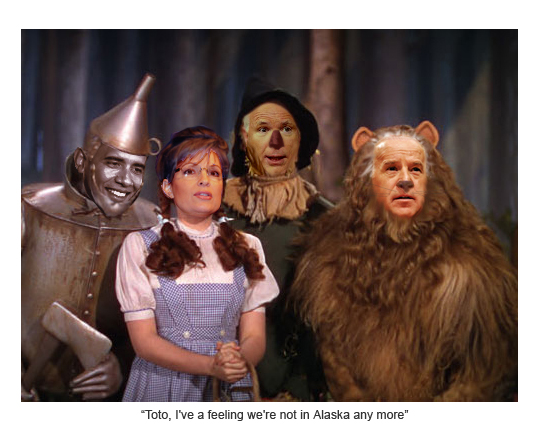
Ha ha ha! I got a kick out of that – especially while reading Wicked with election coverage on in the background!
Posted in Jokes & Humor | No Comments »
Sunday, November 9th, 2008
This is a book that I’ve wanted to read for a long time and thanks to my recent staycation, I was able to purchase, finish, and greatly enjoy this novel. This is the story of Elphaba Thropp – known to the worldwide masses as the Wicked Witch of the West – as written by Gregory Maguire. Why the name Elphaba (pronounced El-fa-ba)? Well that’s easy. It’s a tribute to the author of the original Wizard of Oz novel, L. Frank Baum. L (El), F (fa), B (ba). Since most people will eventually wonder why Maguire chose that name for the Wicked Witch of the West, there you have it.
I was impressed with the depth that this story brings to the Land of Oz and the many races that exist within it. Understand, though, that this is not your Grandmother’s Oz by a long shot. The novel is surprisingly sexual in places and tells certain parts of the story differently than the MGM classic movie. Maguire gives history to the Wicked Witch of the West and by the end of the book has the reader wondering whether or not Elphaba truly is “wicked.”
As much as the story incorporates odd sexual references it includes religious discussions even more. There are communities in Oz that worship an Unnamed God and there are those who believe in a Fairy Queen named Lurline (who has a Christmas-like holiday celebrated each winter in her honor called Lurlinemas). There are others who believe in a simple relationship between good and evil forces and some who believe that the whole of Oz’s past, present, and future are the dreams of a sleeping dragon. And then there are the uncommitted citizens like Elphaba – who believe in neither good nor evil, but do their best to understand each.
Elphaba is joined in this story by Glinda – or as you may call her the Good Witch of the North – and Nessarose, Elphaba’s sister – also known as the Wicked Witch of the East. You remember Nessarose from the movie, right? The one whose feet curl up underneath Dorothy Gale’s house after is squashes her? After reading this story let me tell you – those feet have quite a story behind them! I wonder what L. Frank Baum would have thought about Maguire’s depiction of the Wicked Witch of the East as a religious fanatic who was so devoted to her faith in a land full of half and non-believers that she was thought of to be a witch.
Oh – and Nessarose has no arms in this book.
Bizarre, right? Bizarre might be the best way to describe much of what goes on in Wicked, but the novel is at one time both astonishing and entertaining. Maguire makes the reader wait to the very last pages of this 406 page story for the big payoffs and for answers to some questions posed in the latter parts of the novel. What is interesting is his use of a scene which should be part of the final pages for the prologue to the entire story. After I finished up on page 406 I immediately turned back to the very beginning of the book to re-read the prologue. Though there were no profound revelations in the prologue after having read the entire story, it was certainly interesting to re-read these pages. Keep that in mind if you pick this book up.
Maguire’s retelling of portions of the original Oz story are fun and enjoyable to read, though more adult-themed. His story of the Wicked Witch’s life is fascinating and one that fans of science fiction, fantasy, and good storytelling will enjoy. Who knew that the Wicked Witch was a leader in the equal rights movement between humans and Animals (capitalized for a reason – read the book)? Wicked: The Life and Times of the Wicked Witch of the West receives my highest recommendation.
Posted in Book, DVD, Movie, & Media Reviews | 3 Comments »
Sunday, October 26th, 2008
It’s been a while since I offered some random thoughts on the current state of television, so here we go! Hopefully my rantings make sense to the rest of you like they make sense to me!
The Biggest Loser: Families
For some reason I’m not getting as into this season of The Biggest Loser as I was into the last two seasons. Part of the problem is the contestants on the show. I just don’t care about their successes and failures like I cared about the contestants on the last two seasons. The concept of this season – that families would be competing on the show and that the trainers picked out their own trainees – was a novel one. For my television habits, though, it’s just not working.
Although a large part of the problem is NBC (and this is a recurring problem that you’ll see below). NBC is a great example of a company that is run by people who work with numbers and look only at the bottom line (which, by the way, currently sucks for parent company, GE). You can tell that no one at NBC is watching The Biggest Loser because there is NO way that a competent executive would allow the show to be broadcast the way it is. What does that mean? Well, every single time the show cuts to a commercial it is at a crucial point in the drama being told (whether that drama be real or made up). You can’t do that EVERY single time! Once in a while, you have to give your audience a bone and give them the payoff right there.
Plus, when the show comes back from commercial the viewer is treated to some 30 – 60 seconds of pre-commercial break content before getting to new content. What an insult! This is what you get when you combine “big television corporation” think with a “make more money” mindset.
Crusoe
This is a new show on NBC that follows the “new” adventures of Robinson Crusoe on his deserted island. For those of you that don’t know the story of Robinson Crusoe, it’s the story of a traveling merchant/businessman who is shipwrecked on an abandoned island. While on the island, he befriends a “savage” who is then named “Friday” – the day of the week he was saved by Crusoe. Think Lost and Gilligan’s Island, but starting in literary format almost three hundred years ago.
The first episode showed Crusoe defending his island against both pirates and corrupt Spanish prison guards – both groups which eventually wind up looking for buried treasure. Not a bad plot for a two-hour series premier. I thought the first episode was fun to watch and had the beginnings of a great show. Then the second episode came on…guh.
For some reason Friday and Crusoe spar over meaningless issues. Then we find out that there is a burial ground hidden within a mountain on the island – too Lost-esque for my liking. And not just too Lost-esque, but like a low-end version of Lost being pushed by a corporate powerhouse. Part of this show is also Crusoe’s constant flashbacks to what his life was like off of the island. Those flashbacks worked well in the first episode, but became burdensome in the second episode. Combine this with the fact that NBC doesn’t know how to go into a commercial break and you have the makings of an uncomfortable viewing situation for the people at home.
Finally, the preview for next week’s episode teased whether this would be the week that Crusoe gets off the island. So is this going to be the theme of the show each week? I hope not because that type of plot has no legs. Want proof? The preview suggested that a ship was coming to the island and this may be Crusoe’s chance to get off. Bleh. Wasn’t that the plot of the first episode? Let’s hope NBC doesn’t kill off what could be a good show here.
More thoughts on this season’s television shows coming soon!
Posted in Entertainment | No Comments »
Monday, June 2nd, 2008
Wow. What a novel this was by author Carlos Ruiz Zafón. Before I forget, let me give a shot out to my co-worker Jennifer for letting me borrow her copy of the novel. I haven’t read a good story since The Da Vinci Code and, in my opinion, The Shadow of the Wind blew that b-level drama out of the water. For some history on this book – The Shadow of the Wind was released in Spanish in 2001 and translated to English in 2004. It is a worldwide bestseller and there is a prequel planned for English release next spring.
The story is set in a post-war Barcelona and follows Daniel as he tries to uncover the mystery that is author Julián Carax. Daniel’s interest in Carax is sparked by the knowledge that nearly all of Carax’s novels have been destroyed and that Daniel may have the last copy of “The Shadow of the Wind” – a novel written by Carax himself. Once knowledge of Daniel’s possession of this book is spread, he receives an offer from famed book collector (Barceló) and even runs into a deathly looking figure suggesting that he wanted the novel. You can read more about that in the novel itself…
From this point, the story is about Daniel’s desire to find out all that he can about Julián Carax and his life – hoping to determine why this man’s books have all disappeared. We are also launched into Daniel’s burgeoning self-realization that as a young adult, certain hormones are going crazy. However, in that uniquely Spanish way, Daniel seems to completely fall for one love interest (the blind Clara Barceló) before going head over heels for another one. In truth, I felt a bit bad for Clara at the end of the novel, though most would probably feel bad for her from the start.
What I liked about this novel was that Zafón was able to blend two stories into one. And he didn’t just blend two stories together, he intimately intertwined them so that by the end of the novel the reader is left thinking that one could not exist without the other. Really, it’s a brilliant work of literary art and I was very impressed with Zafón’s ability to do this seamlessly.
Included in this story are a variety of secondary characters that all seem to be as intriguing as the title characters. For example, the loquacious Fermín Romero de Torres could have an entire novel dedicated to his life and times. The Shadow of the Wind was 486 pages long, but I imagine a Fermín Romero de Torres novel being at least twice that size. One of the best characteristics of de Torres is his colorful speech. Zafón truly added to this book by creating such a person to augment Daniel’s youth and inexperience.
There are also characters like Nuria Monfort – a secretary at the publishing house where Carax’s books are published – who are steeped in such mystery that the reader wants to know as much about them as possible. This is also true for Inspector Fumero who was once a schoolyard friend of Carax and winds up being a murdering, disgusting human being. There are probably another three or four novels waiting to be written that deal with this particular cast of characters (including Daniel’s parents).
I highly recommend this book to anyone looking for a good summer read. It’s not the shortest book in the world, but once you get into the story the pages fly by quicker than you would expect. Give it a shot – I think you’ll enjoy it.
Posted in Book, DVD, Movie, & Media Reviews | 2 Comments »
|
|
|
| |
|